
AI for DevOps: Claude Code on Your Infrastructure, Safely
AI agents are great at the parts of ops that eat your day: reading logs, explaining a failing pipeline, drafting Terraform, reviewing a plan for the one line that replaces your database. They're dangerous at the parts that can't be undone. This course draws that line in configuration: read-only identities, deny and ask rules for destructive verbs, plan review as structured output, a triage skill for incidents and CI agents with minimal tokens. Written by a DevOps and cloud architect who works with AWS, Azure and Kubernetes.
Evals for AI Agents: From Vibes to Evidence
Every change to a prompt, a tool or a model changes your agent's behaviour, and « I tried it a few times and it seemed fine » is how regressions reach users. Evals turn that feeling into a number you can trust. You'll build a golden set from real cases, choose graders that check outcomes instead of wording, measure pass rates instead of single runs, and wire it all into CI as a gate. You leave with a working harness you can point at your own agent.
Guardrails in Layers: Securing AI Agents in Practice
An AI agent with tools is no longer a chatbot: it reads e-mails, tickets and web pages written by strangers, and it can act. That makes prompt injection a real security problem, and no prompt or filter solves it alone. In this course you build defence in depth: seven layers, from treating untrusted content as data to least-privilege tools, a sandbox, output validation, human approval, budgets and an injection test suite. Every layer comes with a configuration you write and an attack you run against it.
MCP Done Safely: Connect AI to Your Tools
MCP is the standard way to plug AI agents into your tools: tickets, docs, databases, your own product. Most tutorials stop at « it works ». This one starts there. You'll connect servers in Claude Code with the right scope and permission rules, learn what a malicious or compromised server can do, get OAuth right, and design tools that stay safe when the model is fooled. The last part is a real case study: the MCP server of a production SaaS, including the gaps found while writing this very course, and how they were fixed.
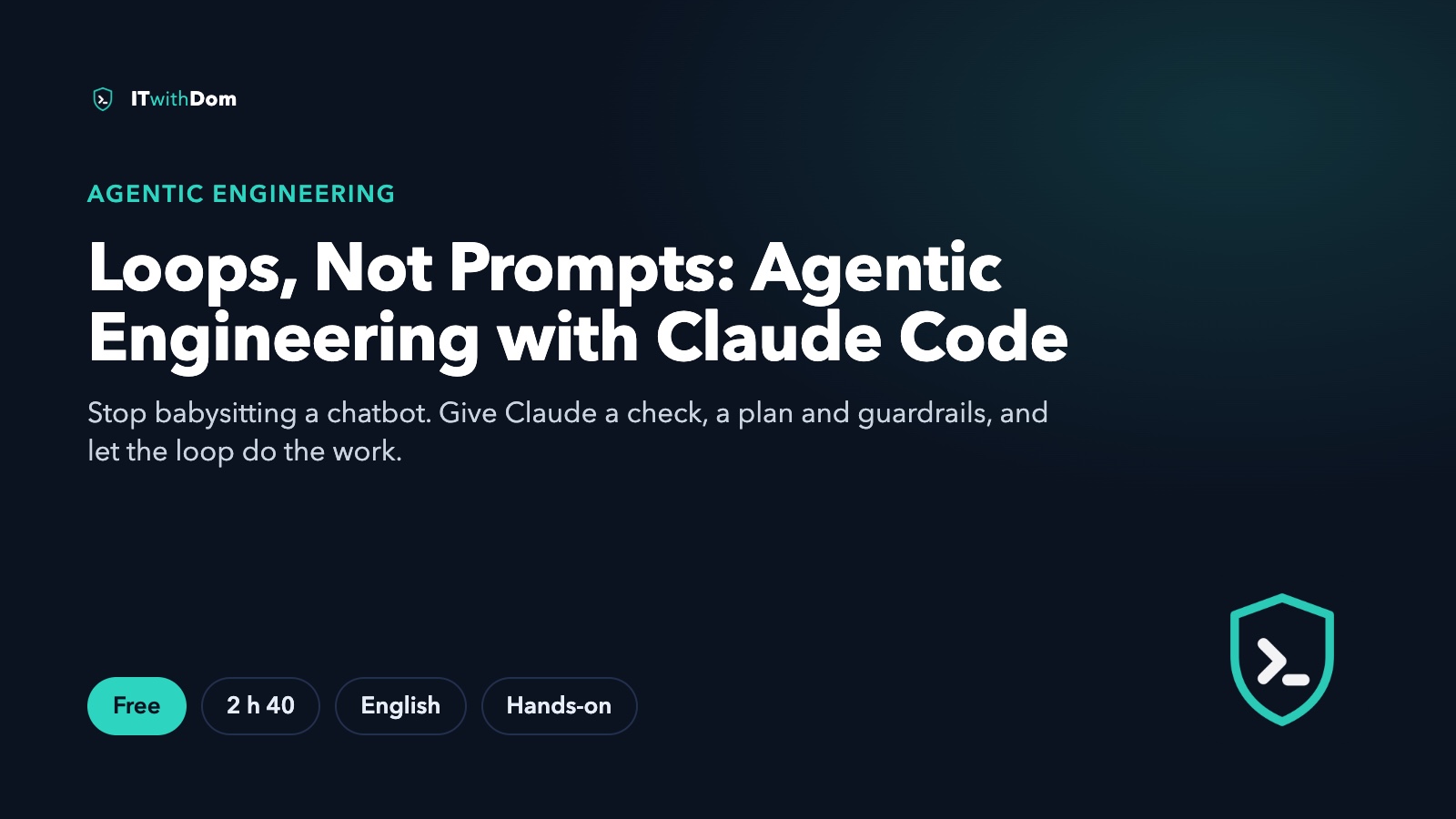
Loops, Not Prompts: Agentic Engineering with Claude Code
Most people use AI coding tools like a smarter autocomplete: type a prompt, read the answer, fix what's wrong, repeat. So you end up as the only quality gate. This course flips it. You'll set up Claude Code so it can check its own work, follow rules that can't be skipped, plan before it builds, split work across subagents and workflows, and run unattended with a budget. Six hands-on exercises, each with a « done when » check and a rubric, plus a final project, all in a real repository.