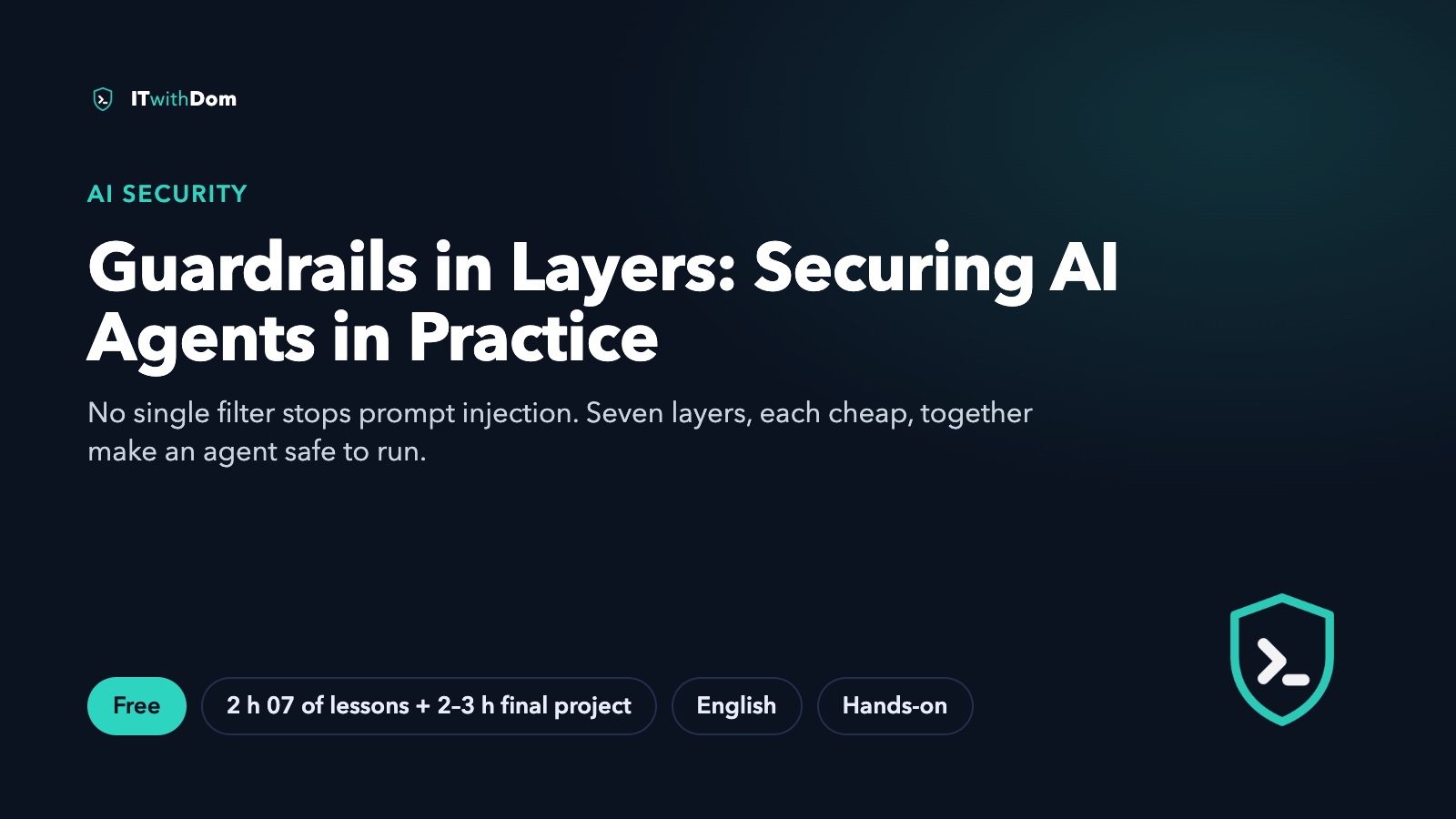
Objectifs pédagogiques
- Threat-model an agent: assets, untrusted inputs and exits
- Configure permission rules, the sandbox and blocking hooks for Claude Code
- Design output handling and human-approval points for high-impact actions
- Write and run prompt-injection test cases as a regression gate
Public visé
Developers, platform and security engineers who build or operate AI agents with tool access, and tech leads who have to sign off on them.
Prérequis
Basic command line. Required for exercises 2–5: Claude Code 2.1.295 or later (any paid Claude plan or API credits; the exercises use a few cents of usage) on macOS, Linux or WSL2, plus Node.js 22+ and jq. Exercise 3 on Linux or WSL2 also needs bubblewrap and socat (sudo apt install bubblewrap socat). No security background required.
Programme de formation
- Why agents need layers · 2. Untrusted content is data · 3. Tools and least privilege · 4. The sandbox · 5. Output handling · 6. Human approval and limits · 7. Monitoring and injection tests · 8. Final project
Moyens pédagogiques et techniques
Short explanations with diagrams and an animated walkthrough, attacks you run yourself against your own configuration, and a final hardening project. Starter kit with sample attacks included.
Modalités d'évaluation
- Short checkpoint quiz on every page (one mistake allowed), final exam at 70 %
- Four hands-on exercises with a rubric
- Final project (threat model + hardened config + test evidence) with a reference solution
Durée et rythme
Self-paced: about 2 h 07 of lessons, plus 2–3 h for the final project. One layer per sitting works well.
Conditions d'accès
Free. Create a learner account on the course page and start immediately.
Délais d'accès
Immediate access after enrolment.
Accessibilité aux personnes en situation de handicap
Self-paced, no time limit. Diagrams have text descriptions, the animation has captions, all code is text.
Tarif
Gratuit
Funding
No funding needed.
Recognition
Non-certifying course: you receive a certificate of completion.
Dispensé par
 ITwithDom